





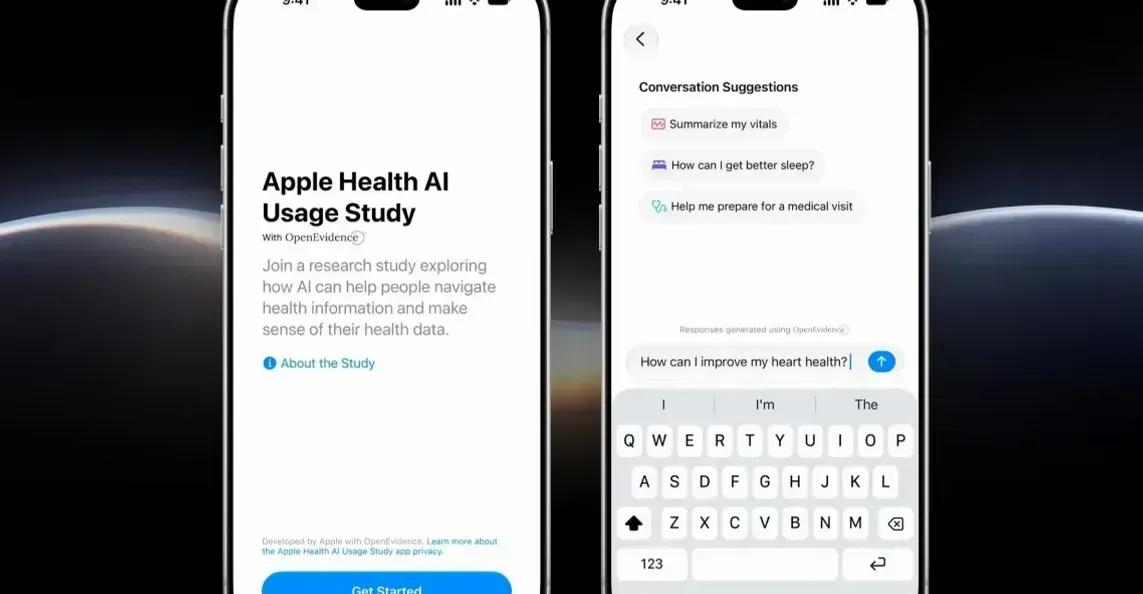

Apple is launching a massive research initiative to figure out how people actually use conversational AI for health advice and whether those digital answers are truly helpful. In partnership with OpenEvidence, a specialized clinical AI platform that draws from prestigious sources like The New England Journal of Medicine, the company is recruiting up to 200,000 volunteers for its Apple Health AI Usage Study. Participants will use a dedicated iOS app to query medical questions and grade the resulting answers on their precision, depth, and overall relevance.
To join the project, users must be at least 21 years old and located in the United States. While the tool focuses on high-level medical insights, there are specific hardware requirements; participants need an iPhone 15 Pro running iOS 26 or later. Interestingly, this particular application operates independently of Siri and Apple Intelligence, relying instead on text-based prompts to provide clear explanations backed by links to peer-reviewed clinical literature.
Privacy remains a central focus as Apple encourages users to optionally sync their HealthKit data, such as sleep patterns and lab results, to give the AI more personal context. Despite this integration, the company insists that user confidentiality is protected and emphasizes that any data gathered during the trial will not be used to train future AI models. The primary objective is simply to refine how these tools are designed so that critical health information becomes more accessible and actionable for the average person.
Sumbul Desai, Apple’s vice president of Health and Fitness, noted that because health is such a personal matter, scientific rigor is essential when introducing new technology into the space. By observing how thousands of people engage with these tools in real-world scenarios, Apple hopes to build a foundation of trust and reliability for future health innovations. This study represents a cautious but ambitious step toward integrating sophisticated medical intelligence into the palms of millions of hands.