






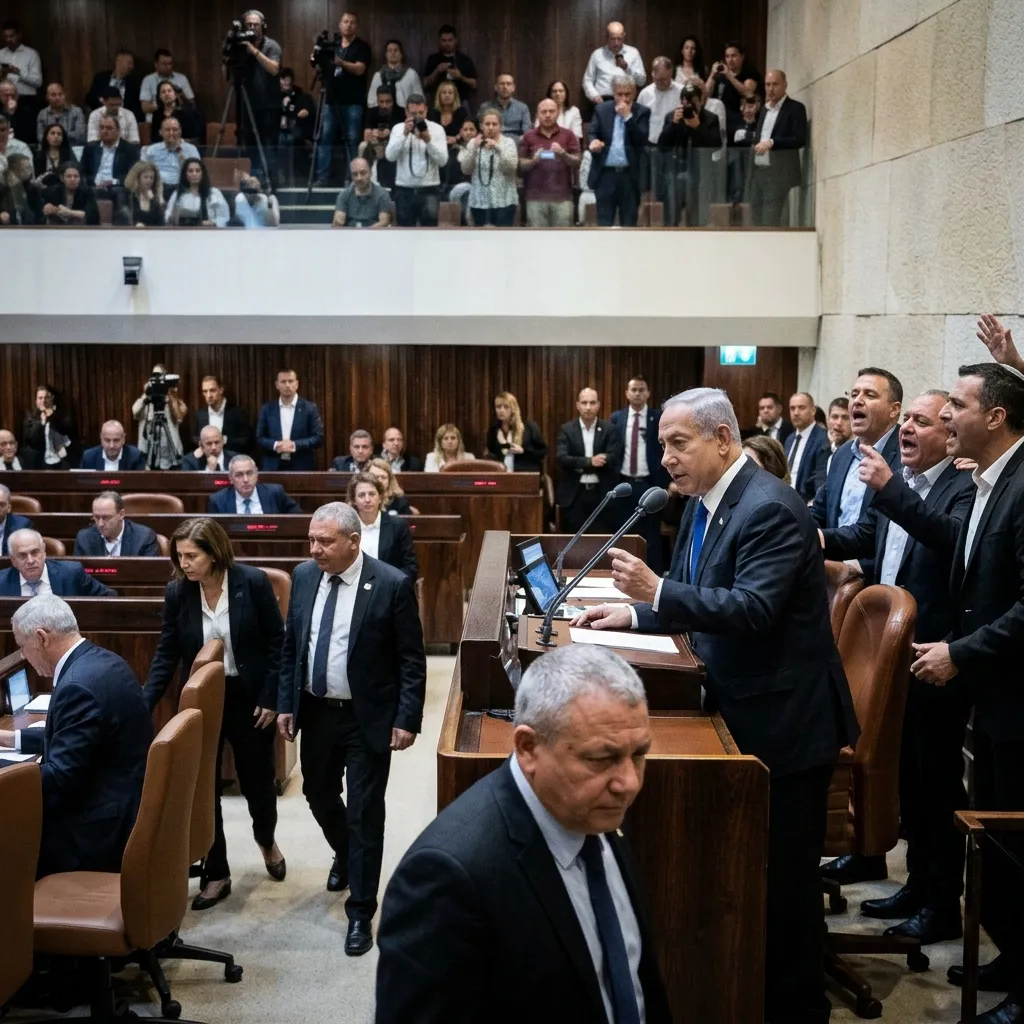

Benjamin Netanyahu’s recent plea for a national unity government served less as a strategic olive branch and more as a desperate attempt to maintain his grip on power. During the swearing-in of Israel’s new parliament, the Prime Minister warned of existential threats from Iran and cast unfounded suspicion on Palestinian lawmakers, claiming they sought the state’s destruction. His rhetoric did little to soothe a volatile chamber, instead triggering a wave of heckles and walkouts. Gadi Eisenkot, who has been tapped to lead the effort in forming a new government, responded by canceling coalition talks with Netanyahu and bluntly declaring him unfit for office.
This chaotic scene is widely seen as the culmination of a shift toward personality politics that Netanyahu himself pioneered over several decades. By transforming his Likud party into a populist vehicle centered on his own image, he fundamentally altered how Israelis engage with their democracy. Political analysts note that voters no longer identify primarily with ideological platforms like Labor or Likud, but rather with individual figures. This transition has effectively americanized the system, making leadership contests feel more like celebrity battles than debates over governance or policy.
However, this obsession with persona has come at a steep price for Israeli civic discourse. Experts argue that when parties become centralized around a single strongman, leaders can operate with near-dictatorial freedom, unconstrained by traditional institutional checks. This environment created the space for Netanyahu to publicly label elected colleagues as terror sympathizers without facing immediate systemic repercussions. The result is what some observers describe as a toxic political culture where deep personal animosities frequently override shared policy goals, paralyzing the legislative process.
As Netanyahu fights for his political survival, he faces a daunting future involving ongoing corruption trials and inevitable inquiries into security failures preceding the October 7 attacks. Yet regardless of whether he remains in power or is finally frozen out by Eisenkot’s efforts to build a viable coalition, his influence persists through the structure he left behind. Even if Netanyahu departs the stage, the precedent of prioritizing charismatic authority over party stability ensures that personality politics will remain the defining characteristic of Israel’s democratic struggle for years to come.